
What is the Surviving Spouse Tax Penalty?
What is the Surviving Spouse Tax Penalty?
(this blog is intended for those over age 65. There are many additional rules for younger individuals)
The Surviving Spouse Tax Penalty, also referred to as the Survivor’s Tax Penalty or Survivor’s Penalty or Widow’s Penalty is simply an increase in income taxes for a surviving spouse who files as single filer vs. married filing jointly after the death of a spouse.
When do I have to pay the Surviving Spouse Tax Penalty?
This tax penalty isn’t necessarily a specific tax a surviving spouse pays, it is merely an increase in taxes as noted above.
What specifically causes the tax penalty or the increase in taxes for a surviving spouse?
When one spouse in a married couple passes away, the amount of income usually doesn’t significantly reduce (assuming the couple is retired). Retirement income usually rolls over to the surviving spouse. This includes but is not limited to IRA income, joint pensions or annuities, along with other non-earned income. Social Security income reduces so the surviving spouse receives 100% of the higher benefit.
The increase in income taxes for a surviving spouse occurs for typically the following reasons:
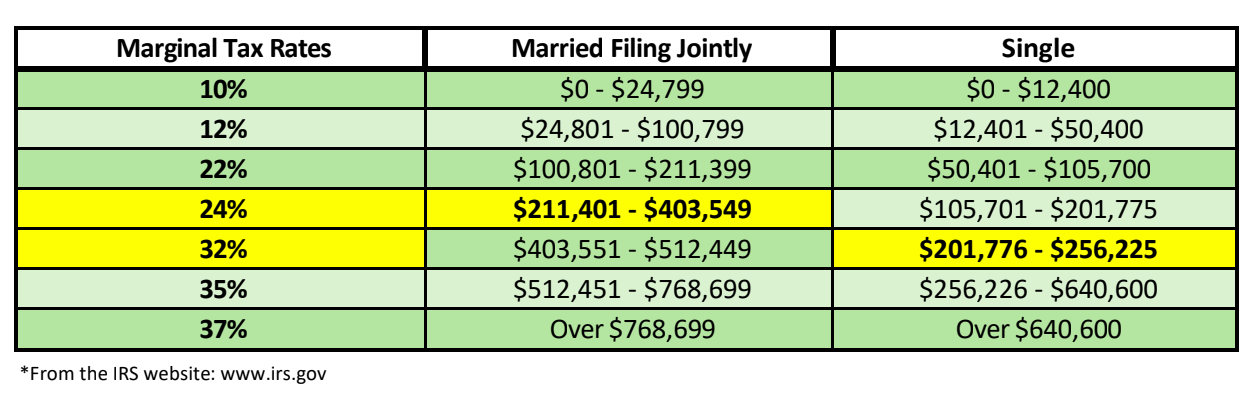
· The tax brackets for married filing jointly are more favorable for 2 individuals filing together than for an individual filing as a single taxpayer. For example, if a married couple has $250,000 of total taxable income, they pay taxes at the 24% marginal tax rate vs. a single filer paying taxes at the 32% marginal rate for $250,000 income.
· The standard deduction is almost half the amount for single filer vs. married filing jointly.
· If over age 65, the additional senior tax deduction is $6,000 per person or $12,000 for married filing jointly.
What can I do to manage or plan for the Surviving Spouse Tax Penalty?
There are a few important times and items to consider when planning:
· In the year of a spouse’s death, the surviving spouse can still file as married filing jointly for the year if he/she does not remarry. In this instance, income may be able to be taxed in lower married filing jointly brackets.
· The additional $6,000 senior deduction is only available as legislated until 2028. Review income tax projections to take advantage of this temporary deduction.
· Medicare Part B premiums can increase for a surviving spouse once filing as single. Charitable donations can reduce income as well as using non taxable sources of income (Roths, HSA, even life insurance) for cash flow if available.
· Last but not least, creating a strategy for Roth conversions during early retirement years can create flexibility with income tax planning.
Please reach out to Amy directly with any questions at amy.kelly@prudential.com.
Content in this material is for general information only and not intended to provide specific individualized tax, legal advice, or recommendations for any individual. We suggest that you discuss your specific situation with a qualified tax or legal advisor.